


 Indonet
Resource sector infrastructure operates under conditions that most civil construction never encounters. Mine haul roads carry trucks weighing 300 to 500 tonnes. Tailings storage facilities must retain hundreds of millions of tonnes of process waste safely over decades. Ore processing plants sit on ground that may be heavily disturbed from previous mining activity, with variable fill, dissolved voids from underground workings, and chemical contamination from historical mineral processing.
The ground engineering challenges in mining and resources infrastructure are, in many respects, the most demanding in the civil construction spectrum. Loads are higher. Chemical environments are more aggressive. Service conditions are more variable. And the consequences of ground failure- haul road collapse under a loaded truck, tailings storage breach, processing plant settlement- range from costly to catastrophic.
Geosynthetic reinforcement grids have become a standard part of ground improvement practice across the resources sector globally, including in Australia where the scale and diversity of mining operations make them a practical necessity. Understanding their role in this specific context- what they can do, where they are most valuable, and how the selection decisions differ from conventional civil applications- is the focus of this piece.
Mine Haul Roads: The Ground Engineering Problem Nobody Talks About
Mine haul roads are among the most heavily loaded unpaved roads anywhere in civil construction. Ultra-class haul trucks used in large open-cut operations have gross vehicle weights of 300 to 500 tonnes, operating at speeds of 40 to 60 kilometres per hour on unpaved road surfaces. The axle loads imposed by these vehicles are an order of magnitude higher than highway freight vehicles, and they are applied repeatedly, around the clock, over road surfaces that are maintained on production-critical timelines.
Poor haul road performance has direct consequences for mine productivity. Rutting and potholing slow truck speeds, increasing cycle times. Rough surfaces increase tyre wear- a significant operating cost for large haul trucks. Wet weather closures halt production. Maintenance grading requires road closures that interrupt haulage. Every hour of reduced haul road performance represents lost production at the face.
The ground beneath mine haul roads is frequently problematic. Mines are rarely located on geologically simple ground with consistently strong, well-graded natural soils. Road alignments cross disturbed ground, variable geology, areas of historic fill from earlier waste disposal, and ground affected by groundwater drawdown from pit dewatering. Building haul roads over this ground using conventional methods- deep aggregate bases, frequent maintenance- is expensive and often impractical at the volumes required.
Geosynthetic reinforcement at the subgrade level reduces the aggregate thickness required to achieve a given performance standard by improving load distribution and confining the granular base course against lateral spreading. For haul roads, this means either a thinner road for equivalent performance, or better performance for an equivalent structural section- both of which translate directly to operational and cost benefits over the life of the road.
PP Biaxial Grids in High-Traffic Unpaved Road Applications
Mine haul roads are dynamic loading applications. The loads are very high, but they are cyclic- each truck passes, the load is applied and then released before the next truck arrives. This cyclic loading profile suits polypropylene geosynthetic grids, which perform reliably under dynamic conditions even where their higher creep susceptibility under sustained static load would be a limitation.
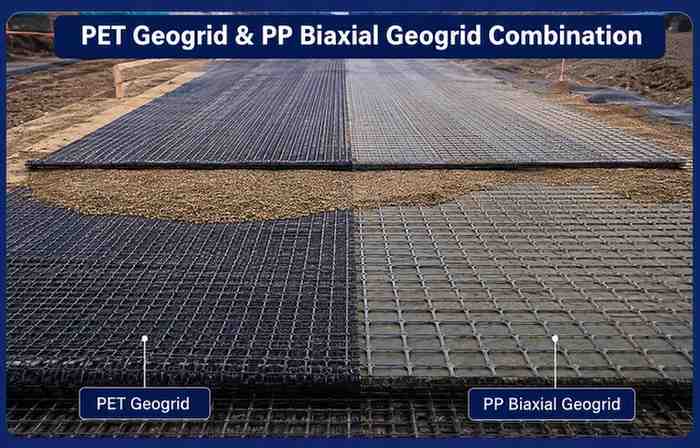
The pp biaxial geogrid is the standard specification for mine haul road base reinforcement globally. Its rigid aperture geometry, manufactured through an extrusion and orientation process, creates strong mechanical interlock with crushed rock aggregate- the typical fill material used in haul road construction. The biaxial strength profile resists the multi-directional stress field created by large-diameter truck tyres, preventing the lateral spreading that causes base course thinning and surface deformation under repeated heavy loading.
Polypropylene also carries a practical advantage in the mining environment. Mine sites frequently involve aggressive ground chemistry- acidic drainage from sulphide mineral oxidation, alkalis from lime treatment of process water, and a range of chemical contaminants from historical and current operations. Polypropylene’s broad chemical resistance makes it a reliable specification choice in this environment without the need for site-specific durability assessment of coating performance that would be required for polyester in the same conditions.
For temporary haul roads- access roads built for the construction phase of a mine expansion, or haul alignments that will be relocated as the pit advances- polypropylene grids represent cost-effective performance improvement with installation simplicity that suits the pace of mining construction programmes. Rolls can be deployed quickly by site crews without specialist equipment, and the aggregate savings relative to unreinforced designs reduce both material cost and the number of truck movements required to deliver road construction materials to remote locations.
Tailings Storage Facility Embankments
Tailings storage facilities (TSFs) are among the most significant geotechnical structures in the mining industry- and among the highest-consequence structures if they fail. A TSF embankment failure can release millions of cubic metres of tailings slurry into the surrounding environment, with the potential for loss of life, long-term environmental damage, and regulatory consequences that can shut down the associated mining operation.
TSF embankment design and construction is governed by increasingly stringent standards following a series of high-profile failures internationally over the past decade. These standards demand robust geotechnical characterisation, conservative design margins, and materials selection that accounts for the specific loading conditions and service environment of each facility.
Geosynthetic reinforcement layers in TSF embankments serve the same fundamental function as in other embankment applications- improving load distribution, controlling differential settlement on variable foundations, and providing tensile resistance that contributes to embankment stability. The specific conditions of TSF construction introduce additional considerations that influence both the design approach and the material selection.
TSF embankments are often raised in stages as the facility fills- new starter embankment is constructed to an initial height, tailings are deposited until the available storage is nearly full, and then the embankment is raised again to create additional capacity. This staged construction means the embankment height and the loads on the foundation increase progressively over the operational life of the facility, which may span 20 to 40 years or more.
The polyester geogrid is specified for permanent reinforcement layers in TSF embankment construction where the chemical conditions are within acceptable limits for polyester durability. The sustained loading imposed by the embankment fill and the staged raising sequence over decades of operation makes creep resistance a critical property- polyester’s low creep rate ensures the reinforcement maintains its structural contribution throughout the operational and post-closure life of the facility.
The post-closure period is a consideration unique to mining infrastructure. Once a mine closes and tailings deposition ends, the TSF must remain stable indefinitely. Design standards for post-closure stability are increasingly demanding long-term performance without active maintenance- a condition that places maximum emphasis on the durability and creep resistance of all structural materials, including geosynthetic reinforcement layers that will remain embedded in the embankment for generations.
Heap Leach Pads and Chemical Resistance Demands
Heap leach operations- where crushed ore is stacked on prepared pads and irrigated with process solution to extract target metals- create some of the most chemically aggressive ground environments in any industrial application. Gold heap leach uses cyanide solutions. Copper heap leach uses sulphuric acid. The liner systems beneath heap leach pads must contain these solutions and prevent them from reaching groundwater, and the structural layers that support the heap must perform under both the chemical exposure and the very high loads imposed by ore stacks that may reach 30 to 50 metres in height.
Geosynthetic materials in heap leach applications are primarily specified for liner and drainage functions, but reinforcement grids are also used in the structural fill layers that support the leach pad and in the access roads on and around the pad. In this chemical environment, polymer selection is governed primarily by chemical resistance rather than mechanical performance alone.
For acid leach environments, polypropylene’s resistance to sulphuric acid at typical heap leach concentrations makes it the appropriate polymer choice for any reinforcement layers that may come into contact with process solution through liner imperfections or drainage system bypass. For cyanide environments, both polyester and polypropylene have reasonable chemical resistance at operational concentrations, and polymer selection can be based primarily on the structural performance requirements.
Operational Variability and the Case for Conservative Specification
Mining operations change. Truck fleets are upgraded to larger models. Production targets are revised upward. Haul road alignments are extended. TSFs are raised beyond their original design height. Processing plant expansions add loads to foundations that were sized for the original footprint.
This operational variability is a characteristic of mining infrastructure that distinguishes it from most civil infrastructure, where the design loads are fixed at the outset and do not change materially over the service life. For geosynthetic reinforcement specifications, it argues toward conservative material selection- choosing products with performance margins that accommodate future loading conditions beyond the original design assumptions.
For permanent structural applications- TSF embankments, processing plant foundations, permanent access road infrastructure- specifying polyester grids where the chemical conditions allow provides a creep performance margin that accommodates the possibility of higher future loads without requiring the reinforcement to be revisited in the design. For temporary and operational infrastructure- haul roads, construction platforms, temporary access- polypropylene grids deliver reliable performance at the loads expected, with the understanding that they will be replaced or upgraded as operational conditions change.
Remote Site Logistics and Material Selection Practicalities
Australian mining operations are frequently located in remote areas where material logistics are a significant project cost and programme constraint. Geosynthetic reinforcement grids are relatively efficient to transport- a roll of geogrid covering several hundred square metres weighs a fraction of the aggregate it enables the designer to save. This transport efficiency is a practical advantage in remote locations where every truck load of construction material represents real cost.
The aggregate savings enabled by geosynthetic reinforcement translate directly into fewer truck movements on remote site access roads, lower fuel consumption, and reduced wear on access infrastructure that is often itself a significant capital asset for the mine. For remote operations where aggregate must be transported long distances from quarry to site, the payback period on the geosynthetic material cost is typically short relative to the aggregate savings achieved over the road’s operating life.
Product availability and supply chain reliability also matter on remote mine sites where project programmes cannot absorb long material lead times. Specifying geosynthetic products that are available from established suppliers with reliable delivery performance reduces procurement risk in a project environment where delays in ground improvement materials can hold up haul road construction and delay production ramp-up.
Ground engineering in the resources sector is not fundamentally different from ground engineering in other industries- the same principles of soil mechanics, load distribution, and material selection apply. What is different is the scale of the loads, the aggressiveness of the chemical environment, the pace of construction, and the operational variability that characterises mining infrastructure over its life. Geosynthetic reinforcement grids, correctly selected for these specific conditions, deliver reliable performance improvements that support safe, productive, and cost-effective resource sector operations.
This post was created with our nice and easy submission form. Create your post!


Comments
0 comments