


 admin
admin
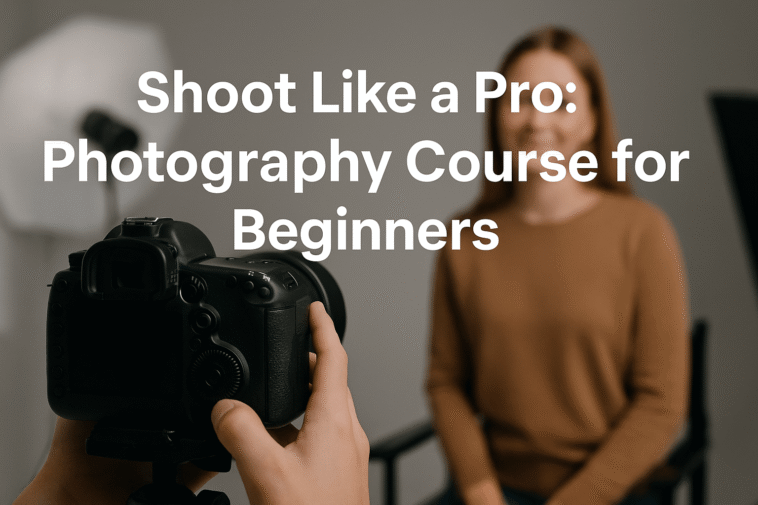
Have you ever looked at a stunning photograph and wondered how the photographer captured that moment with such clarity and emotion?
In today’s visually driven world, the power of a great photograph is undeniable. From social media marketing to cherished family memories, high-quality images are essential. While modern smartphones have improved accessibility, they can’t replicate the control, depth, and artistry achieved with a proper camera and professional knowledge. For anyone serious about moving beyond automatic settings and truly mastering the craft, a comprehensive photography course for beginners is the vital first step.
The creative and media sector in Australia is experiencing robust growth. The Department of Social Services highlights that the Information, Media and Telecommunications industry, which includes professional photographic services, is a significant part of the national economy. This growth signals a continuing demand for skilled image creators, whether they are self-employed professionals, artists, or content creators. Enrolling in a top-tier photography course for beginners is a direct investment in acquiring skills that are valued across multiple industries.
A professional photography course for beginners is meticulously designed to demystify complex concepts. It takes you from struggling with blurry or poorly exposed photos to consistently creating sharp, well-composed, and impactful images. It’s the foundational education that unlocks the full creative potential of your camera and transforms you from an amateur snap-shooter into an intentional, skilled photographer.
10 Core Skills a Photography Course for Beginners Will Teach You
A high-quality photography course for beginners provides a structured learning environment that bypasses the confusion of random internet tutorials. It focuses on building a solid, sequential understanding of technical and creative principles.
1. Demystifying the Exposure Triangle 🔺
This is the cornerstone of all photography. A photography course for beginners will make the relationship between the three main settings clear and actionable.
- Aperture (f-stop): Understanding how it controls the depth of field (how much of the image is in focus) and the amount of light entering the lens. You’ll learn to choose the right f-stop to isolate a portrait subject or keep an entire landscape sharp.
- Shutter Speed: Mastering how this setting controls motion. You’ll learn to use fast speeds to freeze action (like a crashing wave) and slow speeds to create motion blur (like silky water or light trails).
- ISO: Understanding the camera’s sensitivity to light and how to manage it to minimise digital noise while ensuring adequate exposure in low-light situations.
2. Mastering Manual Mode (M) ⚙️
While ‘Auto’ is easy, ‘Manual’ is where the creativity lives. The primary goal of a photography course for beginners is to get you comfortable with taking control.
- Moving Beyond Auto: Learn to consistently shoot in Manual Mode by making deliberate, informed decisions about your Exposure Triangle settings based on your creative vision, not the camera’s algorithm.
- Aperture and Shutter Priority Modes: Understand when to use Aperture Priority (A/Av) and Shutter Priority (S/Tv) for situational shooting, such as sports or landscape photography, where controlling one specific element is key.
- Metering: Learn how to read your camera’s light meter accurately and use techniques like spot metering or evaluative metering to achieve the correct exposure, even in challenging light.
3. Understanding Lenses and Focal Lengths 🔭
A photography course for beginners will explain that the lens is just as important as the camera body.
- Prime vs. Zoom: Learn the pros and cons of fixed focal length (prime) lenses versus variable focal length (zoom) lenses.
- Focal Length Effects: Understand how different focal lengths (e.g., wide-angle $14\text{mm}$, standard $50\text{mm}$, telephoto $200\text{mm}$) affect perspective, compression, and field of view, and which lenses are best for portraits, landscapes, or street photography.
- Crop Factor: If you have a camera with a cropped sensor (APS-C), you will learn how the focal length is effectively changed.
4. Composition and The Rule of Thirds ✨
Technical brilliance is nothing without creative vision. A quality photography course for beginners hones your artistic eye.
- The Rule of Thirds: Learn this fundamental compositional guide for placing key elements at the intersection of imaginary lines to create balanced and dynamic images.
- Leading Lines: Master the use of lines (roads, fences, rivers) to guide the viewer’s eye through the frame and toward the main subject.
- Framing and Symmetry: Explore advanced compositional techniques like using natural frames (windows, doorways) and exploiting perfect symmetry for powerful visual impact.
5. Mastering Focus and Sharpness 🎯
Blurry photos are the beginner’s biggest frustration. A photography course for beginners provides the cure.
- Autofocus Modes: Learn the difference between Single-Shot AF (AF-S/One-Shot), Continuous AF (AF-C/AI Servo), and Automatic AF (AF-A/AI Focus), and when to use each for still subjects versus moving ones.
- Focus Points: Understand how to select and move your camera’s focus points manually to ensure the sharpest area aligns perfectly with your subject’s eye or the most important element.
- Back Button Focus: Often taught as a game-changing professional technique for separating the focusing action from the shutter release.
6. The Magic of Lighting 💡
Photography is the art of painting with light. This crucial module in a photography course for beginners teaches you to read, control, and manipulate available light.
- Direction and Quality: Learn how the direction of light (front, side, back) and its quality (hard, soft, diffused) impacts texture, shadow, and mood.
- Natural Light Secrets: Discover the best times of day to shoot, such as the Golden Hour (sunrise/sunset) and the Blue Hour, for naturally flattering light.
- Using Modifiers: Basic instruction on using simple reflectors, diffusers, and external flashes to improve lighting in challenging scenarios.
7. Understanding Image Files: RAW vs. JPEG 💾
A professional photography course for beginners prepares you for the post-production workflow.
- RAW Files: Learn why shooting in RAW provides maximum image data and flexibility for editing, making it the industry standard for professional work.
- JPEG Files: Understand how these compressed files are processed by the camera and why they are best for immediate use or sharing.
- Colour Space: Grasping the basics of colour spaces like sRGB and Adobe RGB and when to use each for printing versus digital display.
8. Basic Digital Editing Workflow 💻
A photograph isn’t finished until it’s been processed. Your photography course for beginners will introduce you to essential editing software and techniques.
- Non-Destructive Editing: Learn to use software like Adobe Lightroom to make adjustments without permanently altering the original RAW file.
- Essential Adjustments: Mastering core edits like adjusting White Balance, correcting Exposure, boosting Contrast and Saturation, and cropping for better composition.
- Exporting: Learn to correctly resize and export images for different uses (web, print, portfolio) while maintaining optimal quality. This practical skill is vital for any professional taking a photography course for beginner
9. Introduction to Different Genres 🖼️
A professional photography course for beginners provides a taste of various specialisations, helping you find your passion.
- Portraiture: Techniques for posing subjects, flattering light setups, and achieving clean backgrounds.
- Landscape: Tips for using wide-angle lenses, achieving optimal sharpness (hyperfocal distance), and capturing dramatic skies.
- Macro and Close-Up: An introduction to photographing tiny details, using specialised lenses and lighting.
- Street Photography: Ethical and technical considerations for capturing life in public spaces.
10. Building Your Photographic Voice and Portfolio 🎨
Ultimately, photography is a form of personal expression. The best photography course for beginners encourages you to develop your unique style.
- Critique and Feedback: Learning to receive and process constructive criticism to identify weaknesses and improve technical and artistic output.
- Portfolio Curation: Understanding how to select your best work to create a professional, cohesive portfolio that showcases your talent and specialisation.
- Ongoing Practice: The course instils a discipline of consistent practice and experimentation to continually elevate your skills long after you complete your initial photography course for beginners.
Choosing the Right Photography Course for Beginners
The Australian market offers a range of options, from short weekend workshops to comprehensive online certificates.
Online Photography Courses
- Flexibility: Ideal for those with busy schedules, allowing you to learn at your own pace and revisit complex lessons as needed.
- Content: Often feature high-quality video tutorials, interactive quizzes, downloadable resources, and assignment submissions for professional feedback.
- Accessibility: A great, often lower-cost option for regional Australians or those unable to attend metropolitan classes. The best online photography course for beginners ensures practical assignments can be completed anywhere.
In-Person Workshops and Classes
- Hands-On Learning: Provide immediate, supervised practical experience with direct access to instructors for instant feedback and troubleshooting.
- Equipment Access: Some facilities may provide professional lighting and studio gear for practice sessions.
- Networking: An opportunity to connect with other local photographers and build a community.
Taking the Next Step in Your Creative Journey
Enrolling in a professional photography course for beginners is more than just learning settings; it’s about shifting your perception of the world. You’ll stop simply seeing and start observing the way light, shadow, and composition interact.
Whether you aspire to start a profitable side hustle photographing weddings, elevate your small business’s marketing images, or simply capture your children’s milestones beautifully, a structured photography course for beginners provides the roadmap to mastery. The skills you acquire are universally applicable and continually in demand.
To see the power of manual settings and creative composition demonstrated visually, watch this educational video:
https://www.youtube.com/watch?v=lHcA7pPwYZY”>https://www.youtube.com/watch?v=lHcA7pPwYZY</a>
Don’t let your camera gather dust on the “Auto” setting. Take control of your creativity, build a solid foundation, and start producing images that truly stand out. Your journey from enthusiast to expert begins now with a dedicated photography course for beginners.
Are you ready to stop taking pictures and start making photographs?



Comments
0 comments